
A Brief Little Handbook for Artists in Residence
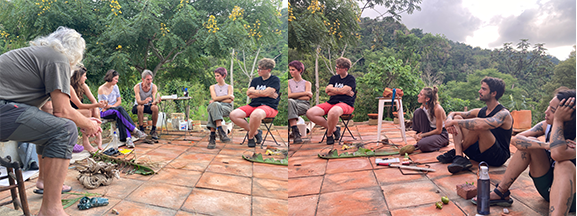
Critical Response Process (CRP) was developed by Liz Lerman in the early 1990s and has been taught in workshops around the world. It’s a structured process for giving and receiving feedback on work in progress. It’s been an integral part of the ArteSumapaz residency cohort’s practice for about three years, with weekly meetings and one-on-one CRP sessions. Most recently, it has even been used in a non-art context, where it was introduced to the Building and Architecture Circle for the review of all building projects.
Statements of Meaning
How I linger
to admire, admire, admire
the things of this world
that are kind, and maybe
also troubled
-Mary Oliver
Introduction
When I first saw a brief clip of Liz Lerman receiving the MacArthur Genius Grant, it led me down a rabbit hole of interest. The thing that I found most compelling was the notion of Statements of Meaning. It resonates with a fundamental philosophy that has been shared with me: that an artist can cultivate an admiring bias towards the word, rather than a critical one.
Imagine walking down a street in an urban setting in which entire neighborhoods have become abandoned. It would be easy to focus on the rusted refrigerators and abandoned cars on the street. I recall such a walk with an artist who never mentioned those things, but instead kept pointing out the beautiful architectural details of the Queen Anne homes, or the patterns in the bluestone sidewalk. You might visit dozens of galleries in Chelsea, and have a similar experience, in which, instead of focusing on the things that are uninspiring for you, you take note of what was admirable.
Judgment is never objective. While it can be a powerful force for liberation, it is also rooted in a patriarchal lineage of exclusion. It has long functioned as a tool to maintain aesthetic and intellectual hierarchies. Maybe that is why judgment is everywhere now: We all feel we might be losing everything, and we cling to the power judgment seems to provide, but it doesn’t. In the age of ultimate gaslighting, it divides and exposes us.
-María Inés Plaza Lazo, “Art Critique as Midwifery of a Shifting Consciousness.”
In the visual arts, we have a peculiar relationship to the critical. I don’t mean simply in art criticism as a practice, but about how we look at work in general. I’ve noticed that, amongst artists, many, particularly emerging artists, long for “harsh feedback.” Perhaps it’s rooted in childhood, when much of a child’s relationship with their parents is one of correction, and thus people might equate criticism with love.
At the same time, the most predominant challenge for artists is their own resilience as makers. Developing the skills for self-management and self-regulation in the arts is the most valuable life skill that makers can nurture, while self-doubt can be the most corrosive.
At ArteSumapaz, we invite artists to actively seek out things to hold in awe. Coming to residency can be a positive, life-transformative experience. That transformation comes from creating an openness in yourself to the different rhythms and energies of the landscape, and even the different cultural attitudes in the community around us. Seeking awe and admiration becomes a reflex with time.
| A Micro-Role Playing GameAs you take a walk from one building to another, seek out something that you can say fills you with awe. Don’t miss the small things. It could be in a blooming flower or the patterns of lichen on a rock. |
Artists asking questions
In my own work, Step Two was the most challenging. I’ve spent over 40 years making paintings in which the opinions of others were intentionally not considered. Instead, this was work that was about sustained contemplation. In the world at large, it’s been shown that the average museum visitor spends less than 17 seconds in front of what are considered many of the greatest paintings, suggesting a crisis of attention. So, how do we, as painters, connect with our viewers?

https://www.instagram.com/reel/DRzjxOLjhvU/?utm_source=ig_web_copy_link&igsh=MzRlODBiNWFlZA==
As an overarching approach, I would first like to describe Step 2 as “What are you most curious about what others experience with your work?” This is, perhaps, a bit more provocative than the simpler idea of “the artist asks questions.”
One way that I found helpful was to craft poetic and evocative questions, like:
- “If this painting were a skin, how would you/it feel?”
- “If this painting came to life, knocked on your door, and asked you out for a date, what would that date be like?”
- “If this piece were a novel, who was the novelist? What was it about?”
For some visual artists, coming up with questions isn’t particularly challenging. But if I encounter one who is struggling as I have, I like to prompt them with a couple of questions, like:
- “What questions do you ask yourself in the process of making a work?”
- “What is it that is important in your work, that you don’t think is easy to perceive by others?”
- “If others really saw your work the way you’d like them to, what do you think they would see?”
These questions can lead to the creation of poetic, evocative questions that, in turn, can spark deep conversations about the work. And once we introduce this way of talking about art, it takes on a life of its own – as though each person in the residency has been permitted to think in this way!
Interestingly, we have had a custom at the residency of playing micro-games at the dinner table. One such game began with the prompt, “if the song of your heart were a place, where would it be?”

So many times, what young artists most want to know is, “Is this any good?” “Is this worthy of attention?” “Which one do you like best?” And that can lead to a wonderful conversation about why that matters, or what, exactly, is “good?” Perhaps a deeper question underlying those questions is “Do you see me?” I’m reminded of Ralph Ellison’s Invisible Man, in which a greater horror than being hated was not being seen.
If an artist is wondering whether they are being seen or worthy of being seen, they could frame their question as a hypothetical future conditional: “How would you feel if…” Artists’ questions are a way to understand better how others perceive our work, but, on a deeper level, they can provoke more profound readings and lead to greater connection.
To conclude, the facilitator working with the artist to uncover their questions may be as profound and as meaningful as the four steps.
One-on-Ones in the visual arts

One of our offerings at ArteSumapaz is one-on-one CRP sessions in addition to the weekly community sessions. A few modest observations have arisen from this practice.
One of the ways that I find that is different in the visual arts than the performing arts is that it’s often unseemly to have opinions about a piece. In this postmodern age, in which art can be anything the artist intends, we have a more challenging role in uncovering the unspoken stories at play. You’ll witness this even in art criticism, where the bluntness of a post-war critic like Clement Greenberg would be discouraged.
So, perhaps as the responder (and facilitator!) in a one-on-one, I might wonder, along with the artist, what might happen if a particular element were sustained, or how the process of the artist is “closed” or “open.” Like an acupuncturist, I might be trying to see where energy is blocked or flowing and to simply recognize blockage or flow, without assigning any value to those elements.
One-on-ones take on a more conspiratorial tone than the group sessions. The artist is often more relaxed than they might be with a large group. I like to spend more time quietly looking at the work before we talk, and then those statements of meaning can bubble up.
A small lexicon for CRP in Spanish
As ours is a bilingual residency and many of our participants are Spanish speakers, we need to adopt a brief Spanish lexicon for CRP.
| Critical Response Process (CRP) | proceso de respuesta crítica (PRC) |
| Responders | respondedoras/respondedoros/ respondedorxs |
| Step One | Paso Uno |
| Statements of meaning | Declaraciones de significado |
| Step Two | Paso Dos |
| Questions from the artist | Preguntas de la artista |
| Step Three | Paso Tres |
| Neutral questions | Preguntas neutrales |
| Step Four | Paso Cuatro |
| To consent | consentir |
| Consent (as nount) | consentimiento |
| Opinions and fix-its | Opiniones y soluciones |
| Consented opinions | opiniones consensuadas |
Solo CRP
I just finished a painting. I’ve cleaned the brushes, and little by little, the overwhelming smell of solvent dissipates. And I breathe in, and ask myself, “What statements of meaning can I make for this work?” This isn’t too difficult – I have, perhaps, surprised myself somewhere in the making of this work. That’s a real delight over there where a brush mark sits beside another, like two old friends.
I’d like to ask myself a question now. Ok, so maybe this part is a bit like playing chess with myself, but no, actually, I do have questions for myself. Did I push through the discomfort? What happens if I sit in the discomfort even longer next time? I’m curious! Does it have as much presence as the last work I finished, over there on the wall?
What if I ask some of those poetic, evocative questions I mentioned above? If this painting was a person, knock on my door and ask me out for a date, where would we go? The painting doesn’t answer, and I’m tired, and the solvents have worked a number on me. I close up the studio and go home. On the way, I remember to seek out something that invokes just a bit of awe.
Closing
The question becomes not: what is this work saying?
But rather: what is it trying to bring into being?
And: what does it require of me to support that process?
Judging is easy.
To support life—this is the real work.”
This bit from a keynote speech given by Maria Inés Plaza Lazo is relevant to what we’re endeavoring to accomplish with CRP at ArteSumapaz. Lazo was speaking specifically about art criticism and suggested that a different model for the role could be found in midwifery, helping art work to be born by the mother/artist. Indeed, as supporters of artists to have positive life-transformative experiences that sustain their practice for years to come, that is our endeavor.
What I demand in all things is life, the potentiality of existence, and that’s that; we need not then ask whether it be beautiful or ugly, the feeling that whatever’s been created possesses life outweighs these two and should be the sole criterion in matters of art.-
-Georg Buchner
Work Cited
Plaza Lazo, María Inés. “Art Critique as Midwifery of a Shifting Consciousness.” Arts of the Working Class, https://artsoftheworkingclass.org/text/art-critique-as-midwifery-of-a-shifting-consciousness. Accessed 9 December 2025.
Oliver, Mary, “Heavy,” downloaded from https://wexnermedical.osu.edu/-/media/files/wexnermedical/patient-care/patient-and-visitor-guide/patient-support-services/spiritual-and-pastoral-care/prayer-request/heavy-by-mary-oliver.pdf
Accessed 9 December 2025.
Büchner, Georg. Lenz., publication unknown, translator unknown
 EN
 ES